The FIA President
 What we've got here is failure to communicate. Some men you just can't reach, so you get what we had here last week which is the way he wants it. Well, he gets it. And I don't like it any more than you men. -- Captain, Road Prison 36
After reading this article on the Steeles' Formula 1 blog and a comment on my previous post made by C-CCP I simply had to give my two cents on the topic.
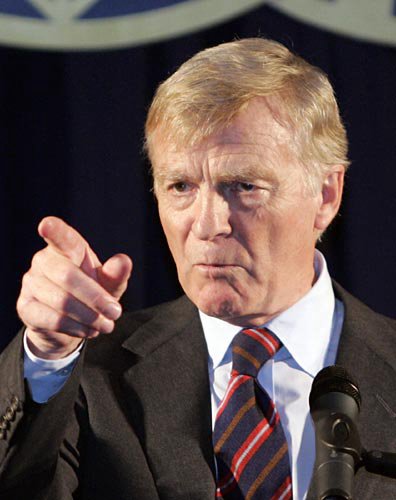
Maximilian Rufus Mosley (GrandPrix.com entry here) has been FIA president since 1991. In total he's been around for 3 terms and now has been re-elected for a fourth four year term. Woe to racing.
Whilst some might think the office of the president sets a person up as a "scapegoat," I rather beg to differ. By contrast, it is the most powerful position in racing, with powers akin to that of Caeser. You see, ultimately, the most presitgious championships in world racing, namely Formula 1, World Rally, GT, Touring Cars and Karting all belong to the FIA. Not for nothing is it called the FIA Formula 1 World Championship. Ultimately, the FIA not only sets the rules but enforces them as well. In a lot of cases, to the chagrin of the competitors in the series.
It is easy to suggest that if people aren't happy with the way things are then the solution is simply to send a candidate to run for president. But as this old article in GrandPrix.com illustrates, the situation isn't quite so straightforward. The FIA is a hotbed of politics and a new candidate simply could not run for the office without going through a political minefield.
It is helpful to think of FIA elections not as general elections in the real world but as political party elections. It took Max Mosley nearly 10 years from the time of the FISA-FOCA wars in the early 80s to finally being elected as president of the FIA in 1991. The GPWC/GPMA - FIA battles by contrast have only just begun. As the GrandPrix.com article states:
"Mosley moved against (former FIA president) Balestre in 1991. He had carefully studied the FISA system and concluded that in order to oust Balestre he would need support from all the automobile clubs around the world, rather than concentrating on winning over the traditionally powerful European clubs, which controlled the FISA. He also realized that regional politics were important as clubs tended to vote with the biggest club in their region. Mexico, for example, carried the votes of most of the central America countries and when Japan voted one way, most of the Asian votes followed suit. Mosley politicked carefully"
Obviously, a new candidate would have to do pretty much the same thing. It isn't just beating on the drum of fairness and transparency as the GPMA does, you first have to placate the FIA's associates who will ultimately hold the key to the elections. This is something that Max has done a long time ago and as these associates are keen to hold on to their considerable local powers, they'd rather be on Max's side than on any new candidate.
It would seem to me that a new candidate would need more political than technical skills if he or she is to run the world motorsports governing body. And this is what we have right now. A lawyer heads the FIA. And like any polticians in parliament or congress, he knows how to wrap an argument in heaps of sugar to make it sound better than it actually is. That Maximilian is a wily old fox of a politician. When it comes to politics, Max is the definitive master. He knows how to speak, when to do so and when to just shut up. See how Indianapolis was resolved in the end. Even though the teams gave evidence that absolved them, it was Max that came out smelling of roses. Not everyone has the skill to go up against PR like that. It takes a crooked lawyer.
Staying on the subject of tyres, let's examine this latest rule change bringing back tyre changes. It is a perfect illustration of Max's power. During the height of the Indianapolis debate and Kimi Raikkonen's Eiffel accident, where many argued against the wisdom of the current tyre regulations, it was Max who stated that it was the teams' responsibility to bring a tyre that could complete an entire race. Where others argued safety Max argued performance.
And yet now, months later, the tyre regulations have been overturned. But why was it overturned? Surely, the FIA could not make the argument on the grounds of safety for that was rejected previously. What about cost, that holy grail that Max is so adamant of seek. From that standpoint this rule change will be costing the teams yet more money to develop yet a new tyre. And so, the FIA made no argument on the matter. In fact, they've not given any reason at all of the complete 180 on the issue. How could they? So, when Michelin issued a public statement questioning the changes, Max's response was to ridicule the complaint and in this case Michelin. As he did in Indianpolis and countless other times in the past.
His response to Michelin's statement was in fact extremely annoying. He asserts that the rule change was supported by an overwhelming majority of the F1 commission. To the casual observer this would seem that Michelin and Michelin shod teams were simply a bunch of morons complaining against the howling wind. But take a closer look at the composition of the F1 commision:
1. The teams - 5 Michelin teams and 5 Bridgestone teams (with the addition of Toyota and Williams)
2. A representative of an engine maker - I'm not sure who's the engine rep. Could it be Cosworth? Whose teams will be using Bridgestone next year.
3. A representative of a tyre company - surprise surprise who else could it be but Bridgestone.
4. The FIA president
5. The F1 commercial rights holder a.k.a. Bernie Ecclestone - joined at the hip with the FIA president.
6. Two sponsors' representatives - No idea who these are but I would imagine they'd have a vested interest with the FIA.
7. Event promoters - oh come on, how likely are the eight of them to go up against Bernie, the man joined at the hip with Max.
Given the members of the F1 commission, of course it would be a majority decision. The Michelin teams never had a chance. But again, there was no legitimate reason given by the FIA for making this rule change. Oh wait, there was but of course they couldn't say it. Quite simply to steal away the advantage of the Michelin runners and hand it back to Bridgestone and their masters at Ferrari. How could one fail to see that Luca di Montezemolo was in rapture at the news. A good commentary on the subject is here on PlanetF1.
Yet, if there was going to be a new candidate for the FIA, perhaps a good chance at it may have been missed. Lately, Max has allegedly been making moves to strengthen his hand even further. As reported in this article on GrandPrix.com, plans for a restructuring of the FIA are afoot. It is suggested that whereas before a single person could run for president nowadays the "president is elected with his team rather than being elected and then choosing a team after the election." See the difference? It isn't simply a lone individual. He or she has to run with an entire "cabinet of ministers" in the elections. As the GrandPrix.com article states, this new system makes the FIA incumbent more likely to be re-elected as it would make more sense for the Establishment to re-elect an experienced team.
There are many reasons to despise the FIA. This whole year has seen numerous can of worms being cracked open. This on top of the forced introduction of V8s and the new aero regulations for this year. All of which has the manufacturers and teams absolutely up in arms. These constant and arbitrary changes in the rules are costing the teams a heck of a lot of money.
Whilst it may look easy to suggest that a candidate be put forth, the truth is the candidate would be stopped dead in his or her tracks if such an attempt were made. Perhaps it would be easier and in the long run far better if the manufacturers did press on ahead with a rival series. I for one am all for it for if the pinnacle of motor racing is run under the banner of such a highly political organisation like the FIA, then I fear the incessant fighting and politics will run on and on forever. As GrandPrix suggests, to beat Max and Bernie, the best way would be to run a brand new championship. As it is the terrible duo has got the FIA and hence the world championship pretty much locked up.