News and views on motorsports

Tuesday, November 08, 2005

Traitor!

I can accept if he was going back to Williams but Adrian Newey's defection to Red Bull, a Ferrari aligned team comes as a huge shock. And what's this? No gardening leave as well. Sacrilege. He'll be taking McLaren's latest to Mateschitz (and Ferrari I bet). Of course Christian Horner is mightily pleased by all of this, proclaiming Newey as bigger than Schumacher.

It comes as a real surprise because if one's been reading Autosport and F1Racing magazine then one would think that Adrian's found a new motivation this season what with his cars doing supremely well and once again the class of the field. I have accused Adrian of being past it and perhaps a little battle fatigued after all this time at McLaren but I would have thought that he'd want to stay on. After such a stunning season McLaren will really miss his services for 2007. The 2006 car I imagine would have already been at an advanced design stage.

Oh well, McLaren can at least take comfort in a bumper 2005 fiscal year.

Cost Cutting

... or why a breakaway Grand Prix series might be a good idea.

The idea of a breakaway series has been discussed a lot this year by the manufacturers currently competing in the FIA Formula 1 world championships. This band includes Honda, Toyota, Renault, Mercedes and BMW. All of them you would agree are absolute heavyweights in the automotive world. All these manufacturers are currently or will mext year be running full works teams. On the other side of the fence in league with FIA/FOM are Ferrari, Red Bull, Midland and Squadra Torro Rosso (yuck). Sitting in the middle of the fence is Williams who have currently lost their works deal with BMW but are poised for a switch to Toyota in 2007.

In recent months websites have reported that despite outward signs of peace between the warring factions, in actual fact the GPMA members are even more resolute on their stand and plans for the breakaway championship are in full swing. Publicly, we have yet to see signs of this.

The reasons given by the GPMA for wanting to breakaway have been covered in depth elsewhere but just to summarize this includes factors such as technical regulatory stability, more equitable income distribution and transparency over all decisions made for the sport.

Whatever the reasons for and against the breakaway series, one thing everyone agrees upon is the need to control costs. There are a number of aspects to this. There are those who argue that regulatory stability itself is a huge way of controlling costs and in turn ensuring a very competitive championship. By keep the regulations stable for a number of years, this ensures that the smaller teams eventually catch up to the big boys.

Everytime the regs change, new technologies or worse new manufacturing methods need to be organised and produced. Those that can afford it will adjust very quickly. Those who cannot will be left for dead. Those left for dead will find it harder to retain sponsorship income and will be left in even greater trouble in the long run.

Yes, there will always be those that can spend more but with rule stability the marginal returns on that spending will be ever decreasing. In the long run the gap that the haves can pull out from the have nots will still be there but that gap will be small. Nothing another Michael or Kimi could not overcome.

On the other hand, the FIA have advocated some radical measures to control costs by means of dumbing down of the technical regulations. Some of these measures include a ban on testing (but yet they let Ferrari run and run) standard specification tyres, standard gearboxes, standard ECUs, standard brakes. God I wouldn't put past them to introduce standard airboxes and the like. In other words, the FIA want to reduce the scope of technical innovations. In this way they argue that exorbitant spending will yield no additional performance whatsoever. Hence, completely negating the advantages of the big manufacturer's limitless bank accounts.

All very well but as this article on GrandPrix.com illustrates trying to reduce spending is a most elusive quest. Right up there with trying to find the cup of Christ. Although, one could start by getting rid of the USD48 million bond teams have to lodge with the FIA. Apparently the FIA earns some USD 2.5 million in interest from that. Perhaps that money should be deposited by teams in a bank instead and earn them that interest.

But really Formula 1 is a victim of its own success. Bernie Ecclestone has done a great job of increasing its profile worldwide. With that worldwide recognition comes increased audience and viewing figures. And with that in turn attracts sponsorship. Companies find they get great worldwide exposure by putting their brand names on cars, billboards, uniforms, helmets etc. A branding exercise that sticks in the mind and builds an image in the audiences minds. Sponsors recognize this power and are prepared to pay the exorbitant prices for it.

Let's say sponsor X hands a team 50 million a year. You can bet your last penny that they will find some way of spending the dosh. In fact, it is their duty to do so. They need to find that extra performance any way they can get. Winning is the name of the game. Its the only thing. And you can bet that whatever technical restrictions are imposed the engineers are smart enough to get round them especially with all that dosh aiding them.

It follows then that the only way to restrict the flow of dosh is if there's fewer sponsors in the sport. One can argue that in these terrible economic times such a thing is happening already. On average though we can say that the pool of sponsorship money is constant. On average mind. In addition to sponsoring different teams, companies also sponsor other forms of motorsports and even other sporting events. Hence that total pool of sponsorship is constant.

If another major world championship were to be run, then the slice of the pie becomes smaller. Hard pressed marketing teams would be working overtime to give the best deals to attract these sponsors. However, the effect would be that teams would have vastly reduced budgets and costs would be contained. The pace of technical innovations would probably suffer as well but I would imagine this would result in more close and competitive racing.

I realise the flaw of my argument. Some teams have made such vast capital investments with incredibly high fixed costs attached. Smaller incomes would make it hard to sustain those costs. But hey, I would imagine that to reduce costs one must not only reduce operating expenditures but capital expenditures as well.

In fact, the teams could recoup those capital investments if the regulations permitted the sale of chassis to privateers as they do in the IRL and formerly in Champ cars. Yes I do realise that if there's less sponsorship dosh going around how can these privateers afford to go racing. Still the effect would be reduced costs.

Some teams I would imagine would have to divest. If cars can be purchased you can bet that companies like Lola and Dallara would be making Formula 1 cars for sale. It would make more sense in some cases to buy off the shelf chassis. Think Team Penske. Once proudly producing their own chassis eventually they found it better to buy Reynards and Lolas and have their factory facilities redeployed for in season development of the cars they buy.

Does cost really need to be reduced? I would imagine that market economics would eventually sort things out even in the crazy world of Formula 1. Teams will simply come and go as the money comes and goes. Teams having incredible successes will dominate for a while but levels of spending cannot go on indefinitely and will soon fall back as economic reality sets in. Other teams will replace them at the top as other sponsors come in.

The cynical would say that the only reason the FIA and Bernie wants to reduce costs is so that there will be more independent teams in the sport. They're easier to control and coerce. These manufacturers are powerful and are difficult to keep in line. Ironic considering that in the nineties Bernie wanted the sport to be dominated by manufacturers to give it a more "legitimate", corporate and professional image. Hence the silly 48 million bond and this "franchise" system where there are no more than 12 teams allowed in Formula 1. I've always considered both these things to be absolute bullshit. A sport should be open to all. Sportsmanship and competition should come first before the needs of corporate image. But now its come to bite Bernie back in the arse. He succeeded in bringing the corporates in to dominate but now he's finding them hard to deal with.

I think the difference in philosophies between the FIA and the GPMA can be illustrated by the example of touring cars. Consider the DTM and the British Touring Car Championship (BTCC). Both of them were widly popular in the nineties. Although the DTM was the more high tech of the two (adopting Class 1 supertouring rules), nevertheless both championships were haunted by the spectre of astronomical costs. All this in what are domestic series mind you.

Something had to be done. The BTCC reacted with a new set of rules akin to the FIA's Formula 1 proposals. Lots of control items like standard throttle bodies, tires, brakes, suspensions (I think?). The BTCC you see today seems rather sad compared to those sexy high tech Class 2 supertourers of the nineties. By contrast the DTM was revived along the NASCAR route. The cars may resemble road cars but in fact underneath they are spaceframe monsters. Huge 4 litre engines are allowed but rev limited to 7500 RPM. Asides some major banned technologies like active suspension et al innovations are more likely in the DTM and more importantly racing suppliers aren't limited here.

Between these two I'd say the DTM is far more successful. However, with the BTCC soon to adopt S2000 rules as per the FIA World Touring Car Championship this might change. Although having said that I do have my reservations on the WTCC as well. The DTM is a good example because the organisers aren't the FIA and the top management have reps from Mercedes, Opel and Audi, the three competing manufacturers. I believe the GPMA is follow a form closely related to the DTM organisation.

Another irony of life. Back in the nineties, Max was all for the high tech Class 1 supertouring regulations for a World or European Championship. Now he's all for backing a lower tech set of rules more akin to Class 2.

Everyone complains of increasing costs that needs to be cut but really there isn't a better way to do that than to reduce cash flows into the sport. Crazy as it may sound but I think two rival grand prix series just might be the only way that it will happen. At least until a clear winner emerges. But don't be mistaken. The GPMA championship I believe can happen and I would imagine has a better than even probability of happening. What it requires most of all is television coverage. World wide terrestrial coverage. A1 Grand Prix has proven that getting that is possible. And if its possible for an Arab sheikh to do it then I'm sure that big time television sponsors like Toyota, Daimler Chrysler and the other manufacturers can manage the same feat. That I believe is why Bernie is so irked with A1GP.

Monday, November 07, 2005

The FIA President

What we've got here is failure to communicate. Some men you just can't reach, so you get what we had here last week which is the way he wants it. Well, he gets it. And I don't like it any more than you men. -- Captain, Road Prison 36

After reading this article on the Steeles' Formula 1 blog and a comment on my previous post made by C-CCP I simply had to give my two cents on the topic.

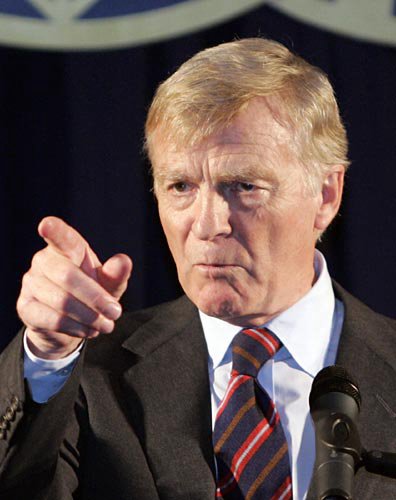
Maximilian Rufus Mosley (GrandPrix.com entry here) has been FIA president since 1991. In total he's been around for 3 terms and now has been re-elected for a fourth four year term. Woe to racing.

Whilst some might think the office of the president sets a person up as a "scapegoat," I rather beg to differ. By contrast, it is the most powerful position in racing, with powers akin to that of Caeser. You see, ultimately, the most presitgious championships in world racing, namely Formula 1, World Rally, GT, Touring Cars and Karting all belong to the FIA. Not for nothing is it called the FIA Formula 1 World Championship. Ultimately, the FIA not only sets the rules but enforces them as well. In a lot of cases, to the chagrin of the competitors in the series.

It is easy to suggest that if people aren't happy with the way things are then the solution is simply to send a candidate to run for president. But as this old article in GrandPrix.com illustrates, the situation isn't quite so straightforward. The FIA is a hotbed of politics and a new candidate simply could not run for the office without going through a political minefield.

It is helpful to think of FIA elections not as general elections in the real world but as political party elections. It took Max Mosley nearly 10 years from the time of the FISA-FOCA wars in the early 80s to finally being elected as president of the FIA in 1991. The GPWC/GPMA - FIA battles by contrast have only just begun. As the GrandPrix.com article states:

"Mosley moved against (former FIA president) Balestre in 1991. He had carefully studied the FISA system and concluded that in order to oust Balestre he would need support from all the automobile clubs around the world, rather than concentrating on winning over the traditionally powerful European clubs, which controlled the FISA. He also realized that regional politics were important as clubs tended to vote with the biggest club in their region. Mexico, for example, carried the votes of most of the central America countries and when Japan voted one way, most of the Asian votes followed suit. Mosley politicked carefully"

Obviously, a new candidate would have to do pretty much the same thing. It isn't just beating on the drum of fairness and transparency as the GPMA does, you first have to placate the FIA's associates who will ultimately hold the key to the elections. This is something that Max has done a long time ago and as these associates are keen to hold on to their considerable local powers, they'd rather be on Max's side than on any new candidate.

It would seem to me that a new candidate would need more political than technical skills if he or she is to run the world motorsports governing body. And this is what we have right now. A lawyer heads the FIA. And like any polticians in parliament or congress, he knows how to wrap an argument in heaps of sugar to make it sound better than it actually is. That Maximilian is a wily old fox of a politician. When it comes to politics, Max is the definitive master. He knows how to speak, when to do so and when to just shut up. See how Indianapolis was resolved in the end. Even though the teams gave evidence that absolved them, it was Max that came out smelling of roses. Not everyone has the skill to go up against PR like that. It takes a crooked lawyer.

Staying on the subject of tyres, let's examine this latest rule change bringing back tyre changes. It is a perfect illustration of Max's power. During the height of the Indianapolis debate and Kimi Raikkonen's Eiffel accident, where many argued against the wisdom of the current tyre regulations, it was Max who stated that it was the teams' responsibility to bring a tyre that could complete an entire race. Where others argued safety Max argued performance.

And yet now, months later, the tyre regulations have been overturned. But why was it overturned? Surely, the FIA could not make the argument on the grounds of safety for that was rejected previously. What about cost, that holy grail that Max is so adamant of seek. From that standpoint this rule change will be costing the teams yet more money to develop yet a new tyre. And so, the FIA made no argument on the matter. In fact, they've not given any reason at all of the complete 180 on the issue. How could they? So, when Michelin issued a public statement questioning the changes, Max's response was to ridicule the complaint and in this case Michelin. As he did in Indianpolis and countless other times in the past.

His response to Michelin's statement was in fact extremely annoying. He asserts that the rule change was supported by an overwhelming majority of the F1 commission. To the casual observer this would seem that Michelin and Michelin shod teams were simply a bunch of morons complaining against the howling wind. But take a closer look at the composition of the F1 commision:

1. The teams - 5 Michelin teams and 5 Bridgestone teams (with the addition of Toyota and Williams)
2. A representative of an engine maker - I'm not sure who's the engine rep. Could it be Cosworth? Whose teams will be using Bridgestone next year.
3. A representative of a tyre company - surprise surprise who else could it be but Bridgestone.
4. The FIA president
5. The F1 commercial rights holder a.k.a. Bernie Ecclestone - joined at the hip with the FIA president.
6. Two sponsors' representatives - No idea who these are but I would imagine they'd have a vested interest with the FIA.
7. Event promoters - oh come on, how likely are the eight of them to go up against Bernie, the man joined at the hip with Max.

Given the members of the F1 commission, of course it would be a majority decision. The Michelin teams never had a chance. But again, there was no legitimate reason given by the FIA for making this rule change. Oh wait, there was but of course they couldn't say it. Quite simply to steal away the advantage of the Michelin runners and hand it back to Bridgestone and their masters at Ferrari. How could one fail to see that Luca di Montezemolo was in rapture at the news. A good commentary on the subject is here on PlanetF1.

Yet, if there was going to be a new candidate for the FIA, perhaps a good chance at it may have been missed. Lately, Max has allegedly been making moves to strengthen his hand even further. As reported in this article on GrandPrix.com, plans for a restructuring of the FIA are afoot. It is suggested that whereas before a single person could run for president nowadays the "president is elected with his team rather than being elected and then choosing a team after the election." See the difference? It isn't simply a lone individual. He or she has to run with an entire "cabinet of ministers" in the elections. As the GrandPrix.com article states, this new system makes the FIA incumbent more likely to be re-elected as it would make more sense for the Establishment to re-elect an experienced team.

There are many reasons to despise the FIA. This whole year has seen numerous can of worms being cracked open. This on top of the forced introduction of V8s and the new aero regulations for this year. All of which has the manufacturers and teams absolutely up in arms. These constant and arbitrary changes in the rules are costing the teams a heck of a lot of money.

Whilst it may look easy to suggest that a candidate be put forth, the truth is the candidate would be stopped dead in his or her tracks if such an attempt were made. Perhaps it would be easier and in the long run far better if the manufacturers did press on ahead with a rival series. I for one am all for it for if the pinnacle of motor racing is run under the banner of such a highly political organisation like the FIA, then I fear the incessant fighting and politics will run on and on forever. As GrandPrix suggests, to beat Max and Bernie, the best way would be to run a brand new championship. As it is the terrible duo has got the FIA and hence the world championship pretty much locked up.