News and views on motorsports

Showing posts with label Tech. Show all posts

Monday, December 04, 2006

Something Interesting

Whenever I'm bored nowadays (like now when I'm in the midst of a major recursive portupgrade) I kinda like to click on the Stumble Button on the Firefox Stumble Upon toolbar. This time, this quite fabulous add-on brought me to this site: http://www.new4stroke.com/. Basically, the authors of the site claim to have created a new form of 4 stroke engine that basically replaces the old valve running gear.

I'm no mechanical engineer (my comment above should tell you the industry I work in) but this invention looks interesting (if it is indeed theirs). I have no idea if it is even theoretically possible but for a guy who's spent a lot of his life looking at various people taking engines apart and fixing them up again, this idea seems brilliant.

The engine utilizes a basic 4 stroke engine block. In the case of the "inventors" an old Fiat short block was used. Then, the cylinder heads are replaced with their invention. Now instead of having the intake and exhaust cycles controlled by cams and valves, the new heads have a single crankshaft. Yes, you read correctly. The heads have a crank. Attached to this overhead crank (??!!) are two pistons per cylinder. One piston is tasked with the air/fuel intake and the other lets exhaust gases out. The pistons move in a reciprocating manner but is pushed by the overhead crankshaft. This in turn in chain driven by the bottom end crank (at least it seems so in the gallery pictures).

Too complicated to explain further, you should have a look for yourself on the website in the How It Works section. Then the mechanical engineers among you can perhaps tell me if this engine should work or not. More importantly, can it burn hydrogen? All I know is right now, this type of engine is automatically banned by the current Formula 1 rules.

Thursday, September 14, 2006

Safety and Gravel Traps

Several years ago, a friend of mine was practising for a saloon car race at Sepang. Rain was pouring down that day and of course he wanted to have a go and get the feel of the car in the wet. Now, my friend has been accused of dubious sanity at times and so it was that day. Coming into turn 12, normally one would stay in third and power out of the turn in the wet. But not he. He decided it to try it in fourth and hope for the best. Well, the tail went and went really fast and he sat there hapless in the driver's seat whilst the car decided it was time to say hello to the gravel.

Now, anyone who's ever built sandcastles would know that a little moisture on the sand will compact the stuff. Well, the gravel on the run off for turn 12 was very wet which made it pretty firm. The car hit the gravel which then sent it rolling over. Thankfully, the roll cage did its job and he was able to walk out and back home to him pregnant wife. No sign of distress or shock, his only complaint was the roof had caved a little and touched his helmet. Incidentally, my friend holds the dubious honour of being the first ever driver to roll over his car at Sepang. Way to go mate! But the point is gravel can indeed be a little dangerous in the wet.

In the dry, it stops a saloon car dead in its tracks with no way out. And formula one cars as well. But sometimes its not unknown for a smooth and relatively flat bottomed single seater to skip over the gravel and plunge directly into the wall. Flipping over can also happen. Wings can break send shards into the cockpit and god knows what other effects incidental to the laws of physics. Which was the argument made by the driver's represented by the Grand Prix Drivers Association for Sunday's race at Monza.

The Monza officials, the FIA and even Bernie jumped in and argued that the high speed safety barriers were state of the art being able to absorb the impact of a Formula 1 travelling at 125mph and yet still be able to keep deceleration forces to tolerable levels for the driver. The Monza officials said that they had no duty to the drivers and only to the FIA. The FIA concurred and said that local officials were under orders to ignore everyone else (including the drivers) when it came to matters of safety. The FIA statement read:

"The owners of circuits licensed for Formula 1 are required not to discuss safety measures with third parties (including drivers)." Pompous arrogant shits. Howzabout they strap themselves into a single seater and crash test the barriers and see if it is a pleasant experience. The GPDA argued that high friction asphalt as used in places like Istanbul was far safer and they would have liked to see them in use in Monza.

But of course that makes sense for given even the slightest whiff of grip and a grand prix car will slow right down to a halt. But if its skipping over gravel (not an unknown occurrence) then no AP Racing calipers and pads will be able to stop a nasty smack in the barriers, which can be a very painful experience. Even crashing into unsecured polystyrene foam can hurt a driver travelling at very high speeds. I've seen that happen at Hockenheim back in the late 80s.


Whatever the case may be I think its one helluva way to treat drivers who are risking their lives out there. Yes, safety improvements have grown leaps and bounds since the 70s but no one wants to be in pain unnecessarily. I think the drivers have legitimate concerns and the FIA and circuit officials need to listen to them. Or at least give some respect to them and meet up as they had agreed at Monza that weekend. The drivers were simply ignored and thats simply not right. Remember it was drivers that started this crusade of safety that the FIA likes to take full credit for in the first place.

Wednesday, March 22, 2006

This Is Nuts

Well, the GPMA may have expressed their support for the sale of SLEC to the CVC but if I were one of the manufacturers this latest bit of madness from the FIA is surely to drive me up the wall. The FIA in the draft 2008 regulations is proposing that:

"Only engines which have been homologated by the FIA in accordance with Appendix 6 may be used at an event during the 2008, 2009 and 2010 seasons."

The said Appendix 6 provides that:

"
1. A homologated engine is an engine identical in every respect to :

(i) an engine delivered to the FIA prior to 1 June 2006 or,
(ii) an engine delivered to the FIA after 1 June 2006, or modified and re-delivered to the FIA after 1 June 2006, which the FIA is satisfied, in its absolute discretion and after full consultation with all other suppliers of engines for the Championship, could fairly and equitably be allowed to compete with other homologated engines.

All such engines should be delivered in such a condition that the seals required under Article 85(d) can be fitted. Engines will be held by the FIA throughout the homologation period.

2. The supplier of a homologated engine and/or the team using the homologated engine must take and/or facilitate such steps as the FIA may at any time and in its absolute discretion determine in order to satisfy the FIA that an engine used at an Event is indeed identical to the corresponding engine delivered to and held by the FIA.
"

In short people, the crazy folks at the FIA are proposing a 3 year engine freeze. 3 bloody years! I don't know about you, but I think this absolutely not Formula 1 anymore.

In a surprising twist however, this proposal was not a Max Mosley original. A previous article on Pitpass mentioned that in a letter to the FIA, it was Flavio Briatore that proposed these rules. It seems that Flavio urged the GPMA members to sign the new Concorde and proposed a number of other measures to "cut costs" including the standard ECU (I'm all for that actually) and get this, a freeze on chassis development as well.

I particularly like this bit in Appendix 6: "... and after full consultation with all other suppliers of engines...."

That should really read : after full consultation with our favourite pet, Ferrari.

And of course I'll bet that Ferrari will be given an absolute magic wand to resubmit a modified and re-delivered engine after 1 June 2006. After all the FIA seemed to agree that their flexi wings, in contravention of the technical regulations are legal items. Whereas McLaren's rear brake steer circa 1998 developed with full consultation with the FIA was banned after protests from Maranello. (** See postscript below)

Alright, putting aside my prejudice, how does the FIA or the other manufacturers for that matter determine that an engine "could fairly and equitably be allowed to compete with other homologated engines?" Oh well, when in doubt they'll probably just ask Ferrari.

Sorry, there I go again. But seriously speaking, this is just inviting more arguments into the sport. Recently, Super Aguri was admitted into the world championship without much ado. But its probably because no one expects them to be any threat at all. Not at this stage anyway. But say, Volkswagen Audi / Porsche wishes to compete I'm sure there will be plenty of discussion as to whether they would compete "fairly and equitably".

And as a fan of Formula 1 and of technology, do I really want to see no progress for three bloody years? And should Mercedes come up with another shoddy engine, do I really want to see a McLaren fighting for last place for three years? There has got to be a better way to do this.

And what happens if for some reason Max Mosley decides in 2008 that this is all wrong and he wants another change of the rules? We've got all these homologated engines with the FIA lying around with costs already sunk. Suddenly, the manufacturers are going to cry foul and protest about researching and producing new engines, incurring more costs, the homologated engines being wasted, so on and so forth.

I really hope my understanding of this situation is incorrect and that Formula 1 doesn't degenerate into this. Ideally I think everyone would like a simple set of rules that promote technology and innovation instead of all this mucking about by the FIA.

As for saving costs. I think the problem is simple. In the first place, the commercial rights for Formula 1 which takes in all television and other revenues from the sport, shouldn't have been flogged off to bloody SLEC and now CVC in the first place. The Formula One Constructors Association, forerunner to the Formula One Administration (or whatever they call it) was originally intended to ensure all the teams got a fair share of the revenues. Bernie should have been fighting for the teams as was the original intent of the FOCA, not to make himself rich with his magic tricks in the fine print. If all the revenues were available to the teams as is their right, then many great teams now long gone would have survived till today.

Now, years on the rights have passed hands once again to CVC. Of course the stiffs there will want a return on their bloody billion dollar purchase. But that return ought to be in the hands of the teams not some bloody investors more interested in the money than any notion of sport. The only recourse I suppose that Max and Bernie can think of to stop more teams from leaving and to attract more teams is to put in these artificial and complicated rules in to "save costs." Dubious measures to save costs are one thing. It would have made more sense to offer these folks revenue instead. But the lions share of those revenues went to Bernie mostly and now to a lesser extent CVC.

The result is the status quo we have today. Bernie may have led the sport into unprecedented worldwide attention it enjoys today but simultaneously it has led to its degradation.

I know in these times everyone is trying so hard to save Formula 1 and there is a spirit of reconciliation and private discussion among the parties. But to me, the sweet has turned sour. If anyone, be it GPMA or some others were to come up with an alternative grand prix series without these complications and of course with worldwide television coverage, I know which series I'd rather watch. There have been controversial proposals in the past 20 years but never have I seen such madness as these today.

(**) Postscript: Sorry folks I just couldn't let it slide. Berrylium, used in Mercedes engines, was banned in Formula 1 back in 2000 or so after Ferrari raised a protest over the material. They cited a safety concern or specifically fire risk. All the while the greatest fire risk is still refuelling which was only brought back into Formula 1 because Ferrari needed it to compensate for the thirsty V12 engines. The real reason for calling for a ban on berrylium was because Maranello could not obtain a monopoly supply of it. The cads. But the point here is: When Maranello wants something it gets it.

Friday, January 27, 2006

Testing Comments

At last, all the top teams have unveiled their challengers and are testing them in earnest. The scene for the 2006 season is starting to emerge. Prior to this Ferrari have been and still are topping the timesheets with the F2004 fitted with the new V8. Its interesting that Ferrari have been using the F2004 for testing rather than the F2005. Clear indication perhaps that last year's challenger was a monumental mistake for Ferrari. This despite Montezemolo's insistence that it was all the fault of Bridgestone.

My impression so far is that Renault and Honda are looking good during these tests. BMW have also been impressive from the times but with these mid field runners you can never tell until the first race is run.

Unlike 2005 where lap times during the long runs count for more as an indication of race performance, this year, where tyre changes are once again allowed, ultimate lap times I believe give us a better indication of the competitiveness of the teams. Once again, races will be run as a series of sprint races punctuated by stops for fresh rubber.

One team that so far has not looked good at all is McLaren. Neither Juan Pablo Montoya yesterday nor Kimi Raikkonen today have set the world alight with the MP4/21. The MP4/20 with V8 fitted does not impress as well. Perhaps the Mercedes Benz V8 is suffering from a lack of power? They're running pretty much the same number of laps as everyone else but their ultimate pace isn't there at all.

By contrast the lads at BAR are reporting a good and successful first test. Barrichello is said to be pretty pleased by his new mount. The car he says has no vices. Indeed the times look good right from the off.

Renault looks like a car of the same mould. Fernando Alonso leading the 2006 challengers from Button in the BAR. We should be watching for cars like these that look impressive straight out of the box. The teams will spend more time improving rather than playing catch up.

Michael Schumacher's run in the 248 F1 looks pretty decent although its only been a day. If the early months of 2005 proved to be good ones for Toyota, 2006 looks like its gone back to 2004 levels of competitiveness, meaning mid runner levels of pace. Not at all what a team aspiring to race wins wants right now. Especially when deadly rivals Honda looks to be blitzing the rest. I keep harping on this point but its fundamental. Honda's got one thing absolutely spot on compared to their rivals. They're based in the right country. Cologne is not where you want to be to build a championship team. I can't help but feel that if Toyota were based in England, where technical and manpower resources are more readily available, they wouldn't seem to be struggling year on year in mediocrity.

Still, its all early days yet. There are some 20 odd days of track running to go. It should be interesting to see how this all plays out. I still believe that this is still going to be a tough year to predict.

Wednesday, December 28, 2005

Eights And Tens

The 2006 Formula 1 technical regulations provide an allowance for certain teams to continue the use of V10 engines. This rule was originally provided for fiscally challenged teams such as Minardi that could not afford a supply of the latest V8s. The regulations state that:

"For 2006 and 2007 only, the FIA reserves the right to allow any team to use an engine complying with the 2005 regulations, provided its crankshaft rotational speed does not exceed a limit fixed from time to time by the FIA so as to ensure that such an engine will only be used a team which does not have access to a competitive 2.4litre V8 engine."

This has been a source of controversy as some have argued that the use of V10s, even after subjecting to rev limits will still prove more powerful than the new V8s. Lately, the Midland team (formerly Jordan Grand Prix) is supposed to have commissioned a study comparing the two engine formats that proves such assertions. Despite mandatory air restrictors and a rev limit of 16,500 RPM, the Cosworth V10 will still produce some 800 bhp. Thats about right I would have thought.

No doubt the V8s will be continously developed and by year end I should think they'd claw back a lot of the disadvantage. However, whatever limit they put on V10s, I think the V8s will suffer still in two respects. The first being torque and second driveability.

The idea is that a 2.4litre engine still suffers a torque disadvantage to a 3.0 litre engine. They may be able to claw back the power disadvantage by making the V8s rev ever higher (power being the rate of doing work) but torque is really a function of capacity. The use of air restrictors and rev limiters I should think would not change that.

The 2006 technical regulations ban all forms of variable intake and exhaust manifolds together with variable valve timing and lift. These technologies make the engine's power and torque curve stay constant or at least linear throughout the rev range. Without these I would imagine the V8s are tuned to maximum power and the delivery of that power will occur over a narrower rev range at or near the rev limits. In fact, some of the drivers testing the V8s this winter have made complaints about the power delivery. This is of course, mitigated by modern electronic control units, with some finely tuned gear ratios and vastly different camshafts.

However, very little can be done about torque. Whilst the torque disadvantage will not be apparent on the faster circuits like Spa (if there is a Belgium Grand Prix next year) with the exception of La Source and The Bus Stop but in places like Monaco where the engine potters along at extremely low revs, Toro Rosso will enjoy a huge advantage. They'll be able to punch out of hairpins a lot quicker than the V8s. In fact wherever the engine spends time in the midrange they'll have a grunt advantage. This includes a lot of the Tilke circuits with its numerous hairpins, slow corners and drag races.

If we assume that Red Bull will bring significantly more financing and technology into Toro Rosso and hence produce better aero and chassis, then the combined effect will be quite explosive. This is not necessarily a bad thing mind you for its time the lads at Faenza enjoyed some advantages.

Tuesday, December 27, 2005

2008 F1 Regulations Update

The full regulations for the 2008 F1 world championships have been released by the FIA subject to ratification by the World Motorsports Council. A supplemental document released by the FIA also highlights the difference between the regulations in 2008 and those in 2006. I've already made some comments on these a couple of postings ago but an article on RaceFax.com made me look even futher.

Now some of these regulations will already be in force for 2006, especially those governing the engine rules. I'm going to highlight them here for posterity and because the regulations are most restrictive.

- Engines must be 90 degree V8s of 2400cc and must not be supercharged.
- Engines must have two inlet and two exhaust valves.
- The regulations go on to specify a maximum cylinder bore diameter, spacing of cylinders and the height of the crank.
- It gets better. The FIA also specifies a minimum engine weight and even the bloody centre of gravity of the engine!
- They've added regulations governing engine throttle which bans any designs that allows the driver to identify the throttle position or assists the driver in holding a specific throttle position.
- Already in force for 2006, variable exhausts and variable inlet manifolds are banned. But in addition, variable valve timing and lift is also banned! Gosh, from 2006 a Honda Civic Type-R has more sophisticated induction and exhaust. Bloody hell, even the crappy bread and butter Civics they sell in Malaysia have more hi-tech.
- Only one injector per cylinder is allowed. Only a single spark plug is allowed with all other forms of ignition banned.
- The only hydraulic, pneumatic or electronic systems allowed in the engine are for control of fluids, the valve system and throttle actuators.
- Any system, design or procedure to reduce inlet temprature is banned. Does this mean no more dry ice?
- The FIA goes on to define a number of materials and alloy/composite compounds. Then it states that these materials are banned. This includes magnesium alloy which if I'm not mistaken is already used in BMW road car engine blocks.
- The FIA then specifies specific materials to be used in the construction of the pistons and valves. Iron based alloys for the crankshaft, camshafts, timing gears, bearings and conrods. Although titanium is also allowed for the conrods.

With the way the FIA structures these regulations, you'd think that simply joining two 1.2 litre Proton Savvy (Renault Clio) engine blocks together will produce a Formula 1 engine. I think that if the FIA are already going to specify standard ECUs and a rev limit of 19000 RPMs then you'd think they'd allow some innovation to appear in the mechanical engine design.

That's not all, even the drivetrain have come under FIA scrutiny. Like throttle, no design permitting a driver to hold a clutch position or identify the position is allowed. Continously variable transmission have been banned for some time now but the FIA is specifying a minimum width for each gear and all gears must be made of steel.

BAR's torque transfer system on the front wheel is banned as expected but any system or design capable of transferring torque from a slower rotating wheel to a faster one is also banned. I'm no engineer but does that mean a ban on Torsen diffs? In which case, some hot hatches in the market would have more sophistication. I suppose these will also exclude electronic diffs.

Is this going to reduce costs? Those who know say that its unlikely. RaceFax gives the example of the Andretti-Green NASCAR team. Despite the most restrictive set of rules in motorsport, this team, arguably the best funded one in the series, is still the strongest one out there. The teams will always find a way to spend the money they have. Controlling costs is not in teams' DNA. Its all about winning.

In addition, with all these restrictions where is the motivation to innovate and come up with new technologies? After all, innovations are equally as likely to come from the smaller teams. Witness ground effects from Lotus or the sliding front wings introduced by Tyrrell in 1990. Exciting products of fertile imaginations from designers wanting to gain the advantage. It seems to me that not only will the FIA fail to control costs but all the money will be spent simply refining existing technologies through test cells, rigs and supercomputer simulation. This I might add merely gives the advantage to the big manufacturers who can afford such things. Innovation on the other hand can be produced by anyone be they a large corporation or a solitary engineer. These rules restrict the ability for such innovation.

I am in favour of some restrictions to Formula 1 technology but I believe these regulations take it a bit too far. I applaud the restrictions on electronics and computer software that augment mechanical systems or to continously fine tune the car according to its position on the circuit and the environment. But surely, there should be scope for innovation in mechanical elements (including suspension and aero) and metallurgy but the FIA it seems is hell bent on eliminating all such things. Just look also at the restrictions on suspension design in the latest regulations.

Its true that sensible restrictions have produced some excellent racing in the likes of Champcars, IRL and GP2. However, here we are speaking of Formula 1, a series that traditionally introduces technology and innovation that is then adopted by the rest of the racing world, especially in open wheel racing. Some of these technologies might even make it on to the road. However, its also true that some of the technology in Formula 1 is prohibitively expensive. Then again, rule stability does allow the backmarkers to evenutally catch up and reduces cost as well.

Thursday, December 22, 2005

Comments On 2008 FIA F1 Rules

The FIA has just made this press release announcing the 2008 Formula 1 regulations. As expected, the FIA has made cost cutting their priority for these new regulations. Some would call it the dumbing down of Formula 1.

But here's a real gem from Mad Max: "The real argument in Formula One is not about sports governance or even about how much money FOM gives the teams. It's all about costs." To the casual observer, this man is simply the business. To those on the inside, time and again the FIA president chooses to ridicule to deflect attention. Yeah Max. Like those 2006 V8 engines are saving the teams a whole load of dosh.

Reflecting Ross Brawn's words last week, the rules have been shaped to "ensure than an independent team with ordinary commercial sponsorship (ie a budget in the order of $100 million - still a vast sum of money in the real world) can compete with a car manufacturer prepared to spend in excess of US$300 million." Still think the FIA and Ferrari aren't in league?

Furthermore from the press release: "“One manufacturer is spending a sum greater than half its total annual dividend. This is unsustainable and sooner or later the shareholders will notice." This statement was to support the notion that manufacturers were spending limitlessly in an unsustainable fashion. Dividends doesn't matter much. Its earnings Mr Mosley. Berkshire Hathaway and up until recently Microsoft issued no dividends at all. Didn't damage their share prices at all. Its all about profits and earnings. That made increases in shareholder wealth not the damned dividends.

Right then on to some specific new rules introduced:


- "New technologies which give a team an advantage for one season but which are then adopted by all teams for subsequent seasons at significant expense will be banned after the end of the first season" Going to have a hard time policing this one I think.

- "The rear wing is split in two." Most experts think this concept won't work but Mr Mosley can dream. If it really goes in, then expect it to be dropped in 2009. Or sooner because its going to be massively unsafe.

- "Limitations on possible “interesting” areas of aerodynamic research." Oh my god. There has got to be some limits to these limitations on innovation. This is Formula 1 after all.

- "Engine to be subject to a rev limit of 19,000 rpm, with a possible increase to 20,000 rpm in consultation with the competing teams." Fully agree with the Establishment on this one. In fact I think the limit should be even lower than this and they should allow for any number of cylinders in an engine. If the FIA wanted to save costs then imposing a lower limit could have independents being competitive on old engines.

- "A standard electronic control unit for engine and gearbox to be used at all times in Formula One." Highly contentious but I agree that this is one of the best ways to control costs. Standard ECUs, standard sensor suites equals less data for computers to calculate and fine tuning (for power) will be more difficult. Whilst some argue that bespoke engines can't be made, this simply isn't true. I'm sure fuel mappings can still be customized according to individual engine makes but the number of parameters determining the maps and its number are limited.

- "Tyre pressures may be adjusted by the driver while the car is moving." Good.

- "Maximum wheel diameter increased to 640mm front and 710mm rear, with maximum widths of 365mm front and 460mm rear with slick tyres." The FIA states that the reason for this is to counteract the loss in downforce by enhancing mechanical grip. Slicks were always a good idea and if the bloody FIA didn't introduce grooves, testing costs would not have been so astronomical.

- "Only permitted materials may be used to construct the car." F***k's sake. But okay, I suppose it'll help the little people.

- "At least 5.75% (m/m) of fuel must be from biological sources." Interesting. A nod at least to the environment, whatever impact a small number of racing cars have on it. Hmmm... but couldn't the oil companies use some "specially formulated" biological fuel mixture with the effect of tremendously boosting engine power? Think toulene "rocket fuel" of the 80s.

- "From 2009 each team may make only two changes of bodywork after the start of the season." This one is so wrong it really hurts. So basically, if you've buggered your aero at the start of the season, you're going to hurt all the way till the end. Thats just plain silly. This means that if a team has a tremendous aero advantage resulting in dominance on the track, you can bet that no other team will have a chance of catching up. We already have mid-season testing restrictions, a limit on development of this sort would be highly detrimental to the spectacle and to competitiveness.

- "It is intended to allow systems for energy storage and recovery (hybrid systems) from 2009, provided this can be done without causing budgetary difficulties for any of the competing teams." Why not promote hydrogen internal combustion engines instead?

Apart from these the FIA will be pushing for sporting regulation ammendments at the World Motorsports Council (WSMC) in 2006 including:

- Single tyre manufacturer. Oh bugger. Why do they need to waste time with the bloody WSMC? Its all kangaroo. You just know they members of the WSMC will bend over forwards to Max on this one.

- "three - Event engines." Crap. They've already got rev limits, why do they need this one?

- "four - Event transmissions" Good for the independents I suppose but see below.

- "weight penalties for early replacement of engine or gearbox." The net effect of this is rather similar to the current 10 place penalty. Depending on the size of the weight penalty, some cars might be rendered uncompetitive especially if its close up front. The fact of the matter is specific life engines and gearboxes are so artificial, penalizes the driver and just makes the championship poorer as witnessed this year.

- "testing restrictions." Err yeah Max. Tell that to your darlings at Ferrari.

- "a limit of two cars per team at an Event" And if there's a crash?

My thoughts are that there are some good rules in here but there are also some very poor ones like CDG and long life engines and boxes with attendant penalties. Then there's the limit on bodywork changes in the season which can lead to the death of any excitement. Some other rules limiting "interesting" aero innovations and limitations on new technology use are vague and I foresee will lead to a great many arguements. Thats probably why Max has been filling the Court Of Appeals with some slick new lawyers. Oh bugger that, the FIA always wins the interpretation anyway so why bother?

And hence back to the main issue. The FIA can argue costs all they want but without transparancy and proper governance, with independent arbitration, costs will keep on rising no matter what these cronies do. But of course, Max and Bernie don't really want that now, do they?

More comments available at GrandPrix.com.

Monday, December 19, 2005

News Comments

The reason why I haven't said anything about the latest testing results at all is that there's just no way to gain any accurate indications about 2006 until next year when all the 2006 spec cars are ready. Up until now we've all got modified 2005 and even 2004 chassis in the case of Ferraris fitted with development V8s and restricted V10s. The tyre manufacturers and the teams are just feeling their way in. So whether its Montagny or Schumacher going fastest is irrelevant at this stage. With 2006 bringing in another round of major rule changes, we can only know for sure a couple of weeks before Bahrain. After all, the F2004M looked quite good in the winter world championship this year but come Sepang, it was (happily) a couple of seconds off the pace.

These new V8s have such vastly different power characteristics. Its one thing to have lower brake horsepower and torque but the power delivery is also vastly different as well. Some speculate, we're looking at a narrower powerband than is usual with the 3.0 V10s. I'd think Renault would finally migrate to a seven speed transmission rather than persisting with their traditional six gears.

I'm not so sure that Toyota have gone down the right route with their TF106. Its front end was developed in 2005 and fitted to the TF105B. Its rear end is new for 2006. Well, with the differences in power characteristics, wouldn't it have been smarter to develop it all as one package once the V8s have had more running? Granted they've been testing their V8 far longer and harder than most teams during the season but surely it would have been wiser to wait until next year to finalise the design. Oh well, I surely hope Mike Gascoyne and Toyota get this one right. In any case, chief designer Gustav Brunner has now left Toyota. Speculation has it that he and Mike Gascoyne did not get along. In any case, I've thought of Brunner as quite a talented designer but at his advanced age he's out of fresh ideas. Witness 2004 when mid-season he simply ran out of ideas to develop the car. Not good in a sport where standing still means getting left behind. Money buys a lot in Formula 1 but not apparently all the ideas.

As we all know, Vodafone has decided not to continue its backing of Maranello and will now be the title sponsor for McLaren. Well done to the marketing folks at Woking for pulling this off. If I'm not mistaken Ferrari were quite confident of extending their deal after its end this year but now has the egg thrown firmly in their face. Annus horribilis indeed for the folks in red. Thrashed completely everywhere in 2005. Well, not to worry Bernie will always think of something for them. Like even more payments.

Now its also common knowledge that Vodafone is also a sponsor for Michael Schumacher. With Vodafone now Woking bound, some speculate that Michael will follow suit. There are of course the denials in the press. But wasn't it a couple of months ago that Herr Schumacher was seen with "friend" Norbert Haug in the pits twice in some apparently deep discussions? With lawyers present as well. Hmmm......

But most disingenuous statement of the week goes to Ross Brawn esquire, who calls for budget cuts across the board in Formula 1. It is the poor that asks for quarter when it comes to fiscal matters. And Ferrari, now with the loss of Vodafone and with parent Fiat in financial meltdown, are getting poorer by the minute. Funny how in previous years, when the kitty was full, they cared not for the plight of the poor whose balance sheets were definitively in the negative. But now of course, they sing the Max Mosley FIA party line. Oh and dear Ross, I'm sure Toyota and Honda's inflated spending were caused by their new windtunnel and team accquisition costs respectively. Confuse asset acquisitions not with operational expenditure. Year on year it is (or was) Ferrari that spent the most, everyone knows that. And yes, if Fiat still spent lavishly on its precious jewel and Vodafone still paid to be associated with Red then you can bet Ferrari will give bugger all to budget cuts.

Again, the issue of cost cutting. It just isn't going to happen. You can bet McLaren will be spending every last penny of that Vodafone sponsorship in an effort to extract the maximum advantage whatever rules the FIA proposes. It just goes somewhere whether this be to better facilities or simulation, the money will be spent. Those who have it will find a good use for it and will if they do things right, gain the advantage on the circuit. Even if that advantage buys them mere thousandths of a second. The only way to reduce budgets is to reduce sponsorship and thats not going to happen. There's just no way.

Thursday, November 17, 2005

A Gift To Sportscar Fans

Sports Prototype fans should head over to Mulsanne Corner. Its an excellent website that walks the user through a whole host of sportscars old and new. Furthermore, it provides lots of interesting technical details on each one of them. The authors display a very high level of technical knowledge that makes the site simply one of the best around.

I thoroughly enjoyed reading details of my favourite cars like the Audi R8, Ferrari 333SP (I'm not a big Ferrari fan but I have a soft spot for this race car), Bentley Speed 8 and BMW LMR V12 (built by Williams). Mulsanne Corner even features interviews with racing car designers, like Peter Elleray, designer of the Bentley EXP.

If I have a wish, it would be for more reviews of old Group C cars like the Jaguar XJR 6/8/9 et al, Toyota 88CV and perhaps one of the most famous and successful one of them all the Porsche 956/962. I know Mulsanne does cover the Joest machine but thats a 1993 model and basically more akin to Richard Lloyd Racing's much modified Porsche 962 GTI. I'd like to see a feature on Joest's 1985 Le Mans winning 956.

The site has actually been around since 2003 but this is the first time I've discovered it but I have a feeling I'll be spending a lot of time on it. There's plenty of cars to read about.

Tuesday, November 08, 2005

Cost Cutting

... or why a breakaway Grand Prix series might be a good idea.

The idea of a breakaway series has been discussed a lot this year by the manufacturers currently competing in the FIA Formula 1 world championships. This band includes Honda, Toyota, Renault, Mercedes and BMW. All of them you would agree are absolute heavyweights in the automotive world. All these manufacturers are currently or will mext year be running full works teams. On the other side of the fence in league with FIA/FOM are Ferrari, Red Bull, Midland and Squadra Torro Rosso (yuck). Sitting in the middle of the fence is Williams who have currently lost their works deal with BMW but are poised for a switch to Toyota in 2007.

In recent months websites have reported that despite outward signs of peace between the warring factions, in actual fact the GPMA members are even more resolute on their stand and plans for the breakaway championship are in full swing. Publicly, we have yet to see signs of this.

The reasons given by the GPMA for wanting to breakaway have been covered in depth elsewhere but just to summarize this includes factors such as technical regulatory stability, more equitable income distribution and transparency over all decisions made for the sport.

Whatever the reasons for and against the breakaway series, one thing everyone agrees upon is the need to control costs. There are a number of aspects to this. There are those who argue that regulatory stability itself is a huge way of controlling costs and in turn ensuring a very competitive championship. By keep the regulations stable for a number of years, this ensures that the smaller teams eventually catch up to the big boys.

Everytime the regs change, new technologies or worse new manufacturing methods need to be organised and produced. Those that can afford it will adjust very quickly. Those who cannot will be left for dead. Those left for dead will find it harder to retain sponsorship income and will be left in even greater trouble in the long run.

Yes, there will always be those that can spend more but with rule stability the marginal returns on that spending will be ever decreasing. In the long run the gap that the haves can pull out from the have nots will still be there but that gap will be small. Nothing another Michael or Kimi could not overcome.

On the other hand, the FIA have advocated some radical measures to control costs by means of dumbing down of the technical regulations. Some of these measures include a ban on testing (but yet they let Ferrari run and run) standard specification tyres, standard gearboxes, standard ECUs, standard brakes. God I wouldn't put past them to introduce standard airboxes and the like. In other words, the FIA want to reduce the scope of technical innovations. In this way they argue that exorbitant spending will yield no additional performance whatsoever. Hence, completely negating the advantages of the big manufacturer's limitless bank accounts.

All very well but as this article on GrandPrix.com illustrates trying to reduce spending is a most elusive quest. Right up there with trying to find the cup of Christ. Although, one could start by getting rid of the USD48 million bond teams have to lodge with the FIA. Apparently the FIA earns some USD 2.5 million in interest from that. Perhaps that money should be deposited by teams in a bank instead and earn them that interest.

But really Formula 1 is a victim of its own success. Bernie Ecclestone has done a great job of increasing its profile worldwide. With that worldwide recognition comes increased audience and viewing figures. And with that in turn attracts sponsorship. Companies find they get great worldwide exposure by putting their brand names on cars, billboards, uniforms, helmets etc. A branding exercise that sticks in the mind and builds an image in the audiences minds. Sponsors recognize this power and are prepared to pay the exorbitant prices for it.

Let's say sponsor X hands a team 50 million a year. You can bet your last penny that they will find some way of spending the dosh. In fact, it is their duty to do so. They need to find that extra performance any way they can get. Winning is the name of the game. Its the only thing. And you can bet that whatever technical restrictions are imposed the engineers are smart enough to get round them especially with all that dosh aiding them.

It follows then that the only way to restrict the flow of dosh is if there's fewer sponsors in the sport. One can argue that in these terrible economic times such a thing is happening already. On average though we can say that the pool of sponsorship money is constant. On average mind. In addition to sponsoring different teams, companies also sponsor other forms of motorsports and even other sporting events. Hence that total pool of sponsorship is constant.

If another major world championship were to be run, then the slice of the pie becomes smaller. Hard pressed marketing teams would be working overtime to give the best deals to attract these sponsors. However, the effect would be that teams would have vastly reduced budgets and costs would be contained. The pace of technical innovations would probably suffer as well but I would imagine this would result in more close and competitive racing.

I realise the flaw of my argument. Some teams have made such vast capital investments with incredibly high fixed costs attached. Smaller incomes would make it hard to sustain those costs. But hey, I would imagine that to reduce costs one must not only reduce operating expenditures but capital expenditures as well.

In fact, the teams could recoup those capital investments if the regulations permitted the sale of chassis to privateers as they do in the IRL and formerly in Champ cars. Yes I do realise that if there's less sponsorship dosh going around how can these privateers afford to go racing. Still the effect would be reduced costs.

Some teams I would imagine would have to divest. If cars can be purchased you can bet that companies like Lola and Dallara would be making Formula 1 cars for sale. It would make more sense in some cases to buy off the shelf chassis. Think Team Penske. Once proudly producing their own chassis eventually they found it better to buy Reynards and Lolas and have their factory facilities redeployed for in season development of the cars they buy.

Does cost really need to be reduced? I would imagine that market economics would eventually sort things out even in the crazy world of Formula 1. Teams will simply come and go as the money comes and goes. Teams having incredible successes will dominate for a while but levels of spending cannot go on indefinitely and will soon fall back as economic reality sets in. Other teams will replace them at the top as other sponsors come in.

The cynical would say that the only reason the FIA and Bernie wants to reduce costs is so that there will be more independent teams in the sport. They're easier to control and coerce. These manufacturers are powerful and are difficult to keep in line. Ironic considering that in the nineties Bernie wanted the sport to be dominated by manufacturers to give it a more "legitimate", corporate and professional image. Hence the silly 48 million bond and this "franchise" system where there are no more than 12 teams allowed in Formula 1. I've always considered both these things to be absolute bullshit. A sport should be open to all. Sportsmanship and competition should come first before the needs of corporate image. But now its come to bite Bernie back in the arse. He succeeded in bringing the corporates in to dominate but now he's finding them hard to deal with.

I think the difference in philosophies between the FIA and the GPMA can be illustrated by the example of touring cars. Consider the DTM and the British Touring Car Championship (BTCC). Both of them were widly popular in the nineties. Although the DTM was the more high tech of the two (adopting Class 1 supertouring rules), nevertheless both championships were haunted by the spectre of astronomical costs. All this in what are domestic series mind you.

Something had to be done. The BTCC reacted with a new set of rules akin to the FIA's Formula 1 proposals. Lots of control items like standard throttle bodies, tires, brakes, suspensions (I think?). The BTCC you see today seems rather sad compared to those sexy high tech Class 2 supertourers of the nineties. By contrast the DTM was revived along the NASCAR route. The cars may resemble road cars but in fact underneath they are spaceframe monsters. Huge 4 litre engines are allowed but rev limited to 7500 RPM. Asides some major banned technologies like active suspension et al innovations are more likely in the DTM and more importantly racing suppliers aren't limited here.

Between these two I'd say the DTM is far more successful. However, with the BTCC soon to adopt S2000 rules as per the FIA World Touring Car Championship this might change. Although having said that I do have my reservations on the WTCC as well. The DTM is a good example because the organisers aren't the FIA and the top management have reps from Mercedes, Opel and Audi, the three competing manufacturers. I believe the GPMA is follow a form closely related to the DTM organisation.

Another irony of life. Back in the nineties, Max was all for the high tech Class 1 supertouring regulations for a World or European Championship. Now he's all for backing a lower tech set of rules more akin to Class 2.

Everyone complains of increasing costs that needs to be cut but really there isn't a better way to do that than to reduce cash flows into the sport. Crazy as it may sound but I think two rival grand prix series just might be the only way that it will happen. At least until a clear winner emerges. But don't be mistaken. The GPMA championship I believe can happen and I would imagine has a better than even probability of happening. What it requires most of all is television coverage. World wide terrestrial coverage. A1 Grand Prix has proven that getting that is possible. And if its possible for an Arab sheikh to do it then I'm sure that big time television sponsors like Toyota, Daimler Chrysler and the other manufacturers can manage the same feat. That I believe is why Bernie is so irked with A1GP.
Tuesday, October 25, 2005

Formula 1 Rule Changes

At a meeting of the F1 Commission recently a number of technical and sporting rule changes were put forward and agreed.

First of is the proposal for yet another qualifying system. This one splits qualifying into three parts. This first two parts being two 15 minute sessions where the slowest five cars will be eliminated in each session. A total of 10 cars will therefore be eliminated from proceedings before a final part which is a 20 minute session where the remaining cars will fight for pole position.

According to this article on GrandPrix.com, as a result of this proposed qualifying session, tyres are no longer restricted to one set for the weekend. However a total of 28 identical tyres (7 sets?) will be allowed per driver per weekend. In addition, tyre changes will be allowed during the race.

Personally I've always preferred a single session where everyone just went for it running on vapour. There was a complaint from the smaller teams notably Jordan that a free sessions would lose them the exposure (air-time) from single lap qualy. However, I do confess to not watch the early part of qualifying because I know its full of slow runners. A lot of folks I know do the same. In fact, if it were a free session, I'd be more inclined to be glued to the telly because you never know when the leaders will be out. This means that I was more likely to watch a Minardi run in previous years than I do during single lap qualifying.

There are merits to this new system. You'll see the leaders in action throughout the session and thats a good thing. There will be battles all the way through the entire session and the brilliant thing is it'll be done on vapour and we'll really see the ultimate pace of the cars and drivers during qualifying as opposed to free practise that we don't get to watch anyway.

I somehow do not think this new system will be too confusing to viewers. Its a knock out system plain and simple. Some are worried about the casual viewer but if they're really interested they'd catch on quite quickly. Otherwise they aren't real motor racing fans and I think I've seen enough of racing diluted and corrupted to meet the expectations of those who have no real interest in this sport.

As for the revised tyre regulations, apparently many of the teams were against it. No prizes for guessing that it was probably the Michelin teams who disagreed. Arguably they're losing a huge advantage but I would agree that its going to raise costs once more.

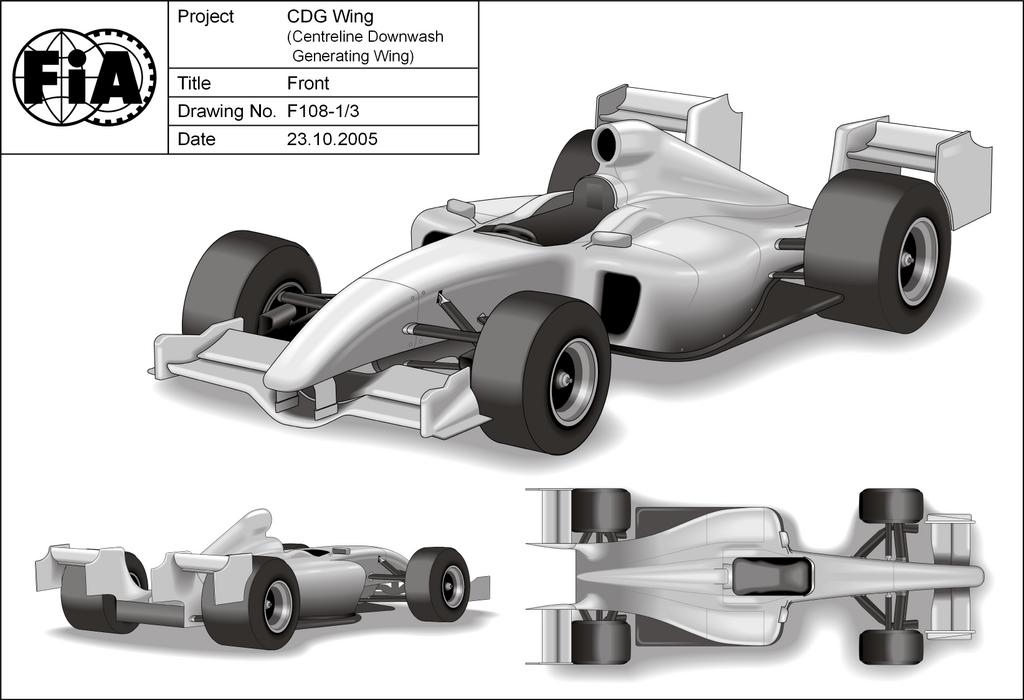
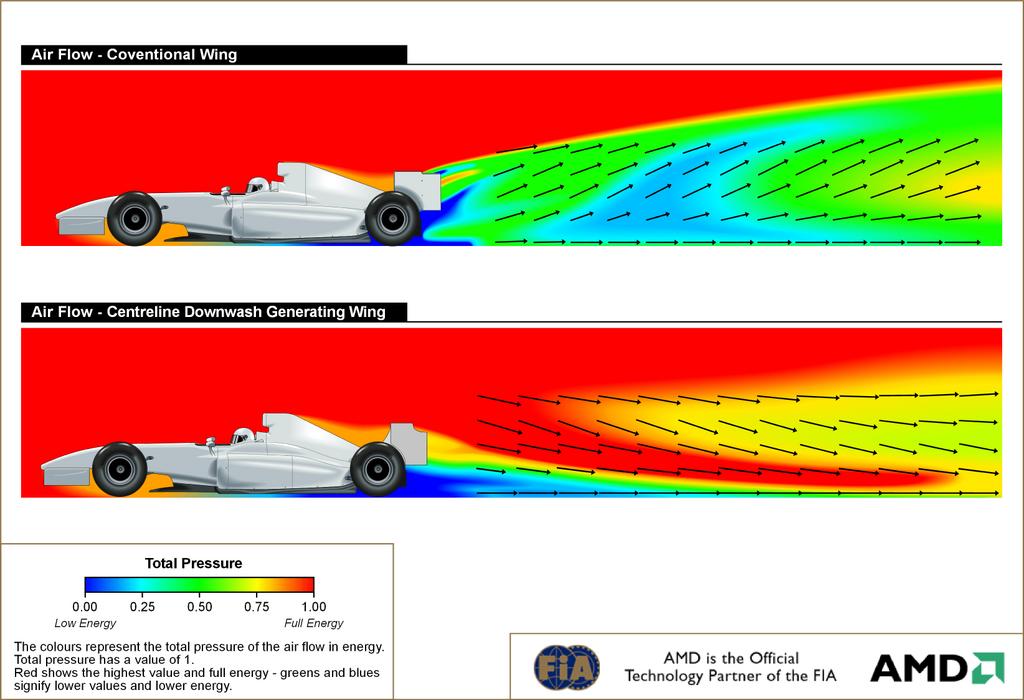
The most radical of changes proposed by the FIA and one which everyone is talking about is this new Centreline Downwash Generating (CDG) wing. You can view the FIA press release here. The CDG wing is best explained visually as per these images.

My first reaction is that they'll lose a huge rear wing to fix sponsorships on to. But on the other hand I guess the marketing folks would probably charge more per square inch for each of the two wings behind the rear wheels.

Second, the rear profile of the car reminds me of old Can Am sports cars. However, the diagram doesn't seem to show any rear diffuser. Does this mean that they will be banned? I hope not. The aero profile in the diagram does suggest that cars following immediately behind will still feel turbulence but they'd have to be absolutely bumper to bumper. A car behind following a little further back will still have plenty of fresh air for their front wings to work.

It seems like a good idea and it would be interesting to see how it works in practise. I'd like to know what the aero profile would be when going through a long fast corner as opposed to merely going in a straight line. I'm hoping it will work out so that we get more 2005 vintage Suzuka races.

Back to tyres, the FIA will be reintroducing wider, fully slick tyres in the future. Finally, they've come to their bloody senses. This should make cars quicker in the turns but the increased drag should slow the cars on the straights. Of course the FIA are adamant that these new tyres will be supplied by a single official supplier. So there will be some cost control there as the FIA will be in a position to dictate compounds and construction.

All in all, some radical but on the face of it, good ideas. We'll probably be seeing them introduced around 2007. However, I would have liked to see the two race engine rule thrown out. And I would have liked to see Max Mosley get a vote of no confidence and thrown out in the forthcoming elections as well. But we can't have everything can we?

Wednesday, September 07, 2005

On Engines

Back when I first started watching Formula 1 the engine to have was the turbocharged 1.5 litre TAG V6. These were designed exclusively for McLaren by Porsche with backing from Mansour Ojjeh's Techniques D'Avant Garde. Coupled with the superb John Barnard designed chassis, it was the class of the field in 1984 and much of 1985. The package took Niki Lauda and Alain Prost to the world title in both years.

Towards the end of the 1985 season, the situation changed. Suddenly it was Honda's V6 engines that were in the ascendency. Clearly the Patrick Head designed cars were much quicker than anyone else. Honda remained at the top of the pile from the end of 1985 till about 1991, winning the constructors championship every year in succession. Honda took Ayrton Senna to his first championship in 1988, the year being the last of the turbo era.

Still Honda's domination continued on at the start of the normally aspirated 3.5 litre formula taking Senna to world titles in 1990 with their V10 and 1991 with a V12. Of course, once in a while some other cars won. Ferrari, Williams-Renault and Benetton Ford being the interlopers during the Honda days but year on year, it was still the engine of choice. Apart from Williams in 1985-1986 and McLaren then on, Honda also supplied the now defunct Lotus team.

During the 1991 season, the writing was on the wall however that the Honda era was coming to an end. The Renault powered Williams clearly more than a match for McLaren-Honda. Some might say Honda made a mistake by switching from V10s to V12 engines in 1991. Ayrton Senna certainly wasn't happy with the V12s despite winning the first four races of that season. During the mid-season Mansell in the Williams was mounting a serious challenge to Senna's championship campaign. Had the Williams been more reliable at the early part of the season, he certainly could have been world champion that year.

On to 1992 and a combination of lighter and more frugal Renault V10 producing nearly as much power as the latest Honda V12 and the excellent FW14B Williams with active suspension saw Mansell winning his first and only world title. Now it was crystal clear. The Renault V10 had firmly established itself as the blue ribband powerplant. This situation persisted until the end of the 1997 season, despite a blip in 1994 when a Benetton Ford in the hands of Michael Schumacher won the title.

Schumacher also won in 1995 in a Benetton Renault. This was his finest season to me, winning in a car that wasn't as good as the similarly powered Williams. The Williams FW17 was clearly the best chassis around but Damon Hill and David Coulthard proved ineffective against Michael. Only when Schumacher left the following season for Ferrari could Damon Hill assert himself and win the title.

Renault left at the end of 1997 but even by then McLaren with their Ilmor designed and built Mercedes V10 was proving itself to be dominant at least in terms of pure speed. At the Italian and Austrian Grand Prix David Coulthard and Mika Hakkinen proved uncatchable.

However, here's where the engine factor ended. From 1998 you couldn't really tell who's engine was superior. This was the year that it all depended on the entire package. Up until 1998, you could tell which were the engines to have and which ones were also rans.

Sure, there were exceptions. Honda engines in a Lotus or Tyrrell (with Mugen) were rubbish. Ligier powered Renaults similarly so. But stick either engine in a decent chassis like a McLaren MP4/4 or a Williams FW14 and they'd fly. Same when they put the Renault V10 in Michael Schumacher's Benetton. Decent chassis, great results.

But nowadays its hard to tell. 19,000 RPM BMW V10s were reputedly the most powerful in the business up until this year but apparently the Williams chassis did not make the best use of it. They say Ferrari's motor is pretty handy but its hard to tell how much is down to the chassis and how much is due to the engine. Toyota's V10s have always had a reputation of being quite useful in terms of horsepower but really how could one tell looking at how leisurely their cars have run. McLaren has the best car out there now but they say the engines a little limp. You wouldn't know it looking at the speed trap figures. In the past it was easy to tell. Nowadays I wouldn't know the difference unless I read it in a magazine somewhere.

The answer of course is that in these modern times its the entire package that counts. Back in the day, you had only one tyre, Goodyear. So that tyre factor was eliminated. But stick a Honda engine in a so-so McLaren chassis (MP4/5B and MP4/6) and get Senna to steer the thing and you'd have a better than even chance of winning some races if not championships.

These days everything counts. Right down to the nuts and bolts. From my outsiders perspective two cars changed it all. The Williams FW14B with its superb aerodynamics courtesy of Adrian Newey and active suspension and the 1998 Ferrari with its specially designed extra wide front Goodyears. Both were able to turn engine and in the case of Ferrari, aero disadvantages around. Nowadays, the whole package counts for more.

In addition, these days there is no one dominant engine as in previous years. There are no equivalents for the Renault in the mid 90s and the Honda in the 80s. All engines are just about there and thereabouts whereas in the past the difference between a superior engine and rubbish motor was just about 100 bhp or even more.

We discount Minardi's antiquated Cosworths from the discussion of course. We know they're giving away 100bhp off the top guys. So, you might say they're doing an excellent job whipping Toyota powered Jordans, who reputedly are running the best motor in the business.

Still you might say that as far as engines are concerned Formula 1 is incredibly competitive. Ferrari, Renault, Toyota, Honda, BMW, Mercedes and even Cosworth are producing power units that are all within shouting distance of one another. Only the package in which they are installed making all the difference.

I believe this situation has come about because of the heavy investment and technical facilities of the big manufacturers. Otherwise you'd have rubbish Judd engines trying to take on the might of Honda as did happen in the late 80s. With the availability of engines from the big boys, you eliminate engines as an all important factor. I suppose then if you had a single tyre manufacturer then you'd eliminate tyres as well leaving chassis and aero as the deciding factor. And of course the drivers.

So in the end, despite all of Max and Bernie's anti-manufacturer antics, they'd do well to pay them more respect. Their presence in the sport does have its good points.

Tuesday, July 12, 2005

Boost Button

Max Mosley who was once heard to dismiss overtaking as unimportant to the fans, has now done a complete U turn on the issue. Having heard the voice of the fans, he wants overtaking to be a major feature. It just shows you how out of touch these FIA types are to audiences.

Anyway, Mad Max has now proposed a boost button that when depressed, would give an extra power boost to the car to allow it to overtake the rival in front. The power boost works by storing energy released under braking into a battery. It would then be used to somehow give a quick squirt of power for the driver to overtake.

It sounds like a system used in Indycars I believe. But doesn't BAR already have an "overtake" button for its Honda engine?

Also, I agree with the Pitpass article. Whats needed is not artificial measures like these to improve overtaking but driver skill and bravery. Also, the aerodynamics of the car must be such that turbulence does not affect it so much as to render overtaking impossible.

A better proposal I think is to introduce measures to reduce reliance on front wing produced downforce. In fact, instead of reducing the length of the venturi tunnels as they did this year, it should be extended. In fact, they should use the Indycar / Champcar style aero that allows tunnels all the way to the front of the car. That way a very large portion of downforce is produced by the body of the car instead of the wings.

Sliding side skirts can still be banned. Think of the old Group C / Le Mans sports car style aero. If you discount the front bodywork, those cars in fact have little or no front wings. Think Porsche 956/962. It had no front wing (unless you count the bodywork itself) and a small rear wing but good downforce was produced by its long venturi tunnels running throughout the length of the car.

In fact Tyrell introduced the sliding skirted front wing in 1990 and was used by the likes of Williams and McLaren all through 1991 and 1992 before being banned in 1993. Or was it 1994? I can't remember exactly. The point is, those wings relied on ground effects to produce its downforce. The sliding skirts ensured that air was being sucked right through underneath the wings and channelled into the low pressure area behind rear brakes. The top of the wing was guaranteed to be at a high pressure, thus producing downforce.

The wings these days need lots of fresh air, which when its behind another car, is none existent. All this from the people who said that regulations should no longer be the premise of team technical directors. Dumb ass lawyer.

You see a lot more overtaking in Champcars and Indycars because they have "proper" aero. Yes, they have boost buttons in Indycars as well but it really isn't needed. If the aero on the car works fine drivers will find a way past. At moment, they haven't got the grip to give it a good lunge for an inside pass.

No boost buttons in karts but its overtaking galore there. Aerodynamics and downforce are nice to have and in a series like Formula 1 generates interest among the tech enthusiast. They just need proper ones. Its probably the only impediment left to a good show.

Williams' Engine

There have been many rumours and speculation on this topic over the last couple of months and especially once it was confirmed that BMW will now have a works team in Formula 1.

GrandPrix.com is carrying this story telling how Williams might use Cosworth next year before switching to a Lexus badged Toyota engine for 2007. It has also been speculated that Honda might do a deal with Williams if they agree to let the BAR team keep Jenson Button for next year and beyond. Meanwhile Sam Michael, the Williams technical director, is screaming for some sort of decision to be made, obviously so that he can get on with designing next year's car. The later the decision comes, the less time he has.

There are pros and cons of each supplier. With Cosworth, Williams will presumably be getting their near exclusive attention, notwithstanding a supply to Minardi of rev limited V10s next year. On the flip side, Cosworth cannot command the resources of the manufacturers. But would they need to? V8s have been Cosworth's speciality for ages ever since the introduction of the famous double four valve (DFV) Cosworth engines in the 1960s. Today, Cosworth still supplies V8s to Indycar and Champcar. And their V10s are pretty handy as well. Also, their new F1 V8 is already in an advanced state of development over the rest. Whether they can sustain that lead is another matter but Cosworth is specialist manufacturer par excellence.

With Honda, Williams would still be tied to a manufacturer although it probably means a "customer" unit. The Toyota deal looks more promising. With all three options, Williams just might have to pay for engines next year but thats something they want to avoid. Williams could also stay with BMW, as Mario Thiessen have an open invitation to them for a continued supply. That to me is actually the best option especially since BMW promises them works quality engines. But the problem is most likely a human one. The relationship between these two companies have been soured and damaged perhaps to a point of no return now.

In the final analysis, the choice of engine partner is irrelevant for one reason. Williams have got to get the car sorted out first. In the May 2005 issue of F1 Racing magazine, it is estimated that the most powerful engines in F1 are Toyota, BMW and Ferrari in that order (930-970bhp). And yet, the fastest car at the moment is the McLaren powered by perhaps the most puny engine (around 900 - 920 bhp) of the lot (Minardi excepted). However, McLaren have got things absolutely sorted. Williams are still screwing around.

Unlike in the 1980s or the mid-1990s, when one absolutely and simply must have a Honda and later a Renault engine for any chance of championship success (Ford powered Benetton being the exception), the glut of manufacturers involved in Formula 1 today ensures that the choice of engine is not such an important factor. If your car is sorted, you will be competitive. All engines are producing roughly the same power, all around the 900 bhp mark or more. But could you imagine a Toyota powered McLaren? Renault and the rest would be eating dust every weekend. But as it stands they're still doing the business.

Never mind BMW, this is the leanest spell for Grove ever since they started grand prix racing. Come 2007, this spell would have stretched to 10 years without a world title. The previous lean spell would arguably be the period between Keke Rosberg's 1982 title and Nelson Piquet's third title in 1987. After the successes of the 90s with the likes of Mansell, Prost, Hill and Villeneuve, Williams are starting to lose their credibility.

So perhaps they should just swallow their pride and start dishing out dosh for engines. They aren't as blue chip as before. Perhaps the most insulting thing I've read about them is a Reuters journalist calling them wannabes a few seasons ago. Williams??? A wannabe?

At the moment, Jenson Button would probably be wise to remain at Brackley. The continuity and commitment by Honda will probably produce better results for him over there than at Grove. Williams will still be finding their feet for at least 2 to 3 seasons more the way it looks. Unless of course they can play nice with BMW.

Finally, I have no doubt that young Sam Michael is a genius. But is a software developer really qualified to lead the technical department at Williams? I would imagine they'd be better off with someone who has some mechanical or aero engineering qualifications, as in an Adrian Newey, a Pat Symonds or a Mike Gascoyne. Oh well, in this I'm no expert and I'm sure Patrick Head knows what he's doing. Despite the dismal results.

Update: Toyota says no to Williams for 2006 but is a possibility for 2007. Honda meanwhile says that time is running out.

Friday, July 08, 2005

Fans Love The Classics

The results of the FIA survey is in. I was particularly interested in the bit about circuits.

Absolutely wonderful to see that fans around the world agree that classic tracks like Monaco, Spa and Silverstone are tops, whereas most of the Tilke designed dogs are way down the order. Are you hearing this Hermann? Your tracks suck and most people wouldn't give a damn if they disappeared.

Sepang is actually way down the list if you discount newly constructed Istanbul, Shanghai and Bahrain. In fact only the ungodly Hungaroring does worse. And that makes me sad because I've always thought Moron Tilke concentrated more on the shopping strip in the middle of the track rather than the track itself. I really wished he had designed to track better and made it faster. Everytime I drive in Sepang, those slow corners turns 1, 2, 4, 9, 14 and 15 just makes me frustrated. Instead of giving us sweeps and fast turns, he gave us hairpin after hairpin, drag race after drag race.

I think Bernie should give credit then to Silverstone and Spa and quit harping on about places like Sepang and Shanghai. They're dogs Bernie. Silverstones got more character in Copse corner alone than the entire Shanghai track put together. Ask any of the racers racing in Northants this weekend. They all love it. Only Bernie seem to have a problem.

Other interesting facts about circuits is that younger fans seem to want more countries and new circuits added to the calendar whereas older punters (I think that it includes me) couldn't give a damn. In fact, I think screw adding newer countries but bring back more classic racing tracks. Like Brands for instance or Bernie's own Paul Ricard for another.

The order of circuits in the survey:
1. Monaco
2. Spa (This really should've been number 1)
3. Silverstone (Those who've driven on it absolutely love it. Including yours truly)
4. Monza (I was a passenger in a taxi ride around this one. Back in the day when it was way, way quicker)
5. Suzuka (May it always host the Japanese Grand Prix instead of the Tilke modified dog at Fuji)
6. Imola
7. Montreal
8. Hockenheim (How did this dog get all the way up here?)
9. Nurburgring (Hmm.... must be those bloody Germans)
10. Melbourne
11. Indianapolis (Yeah, but would the Americans still want to watch F1 over there?)
12. Interlagos
13. Barcelona
14. Magny-Cours (Deserves a higher placing than Nurburgring)
15. Sepang (They should get rid of all the circuits from this one and all below).
16. Hungaroring (How did it ever make it into F1 in the first place?)
17. Bahrain (Sucks)
18. Shanghai (Sucks big time)
19. Istanbul (Remains to be seen but looks like it would suck)

Wednesday, May 25, 2005

Experts Agree: Tilke's Ring Sucks

The Nurburgring has come under some criticism from grand prix drivers in this story on F1Racing.net. Former world champion Jacques Villeneuve calling the first sector of the circuit "really annoyinng," adding that it was also "slow and boring."

Giancarlo Fisichella and Jarno Trulli also having less than flattering words about this circuit.

If Villeneuve thinks the Nurburgring is slow and boring then I bet he'd lambast the Fuji circuit, recently modified by Tilke. The final sector on that track is excrutiatingly slow and absolutely frustrating. But this seems to be Tilke's favourite way of renovating otherwise fantastic old circuits.

Why do Max and Bernie persist in using this guy to do all the circuit work? Most people I should think, want to see cars go quickly in the corners. It really shows their speed. Yet he loves his slow, sickening hairpins. And it seems drivers themselves are sick of his stupidity.

Thursday, May 12, 2005

Blockhead

I can't believe Luca di Montezemolo sometimes. In this article in F1Racing.net the formidable head of the albeit crumbling Fiat empire lambasts the current rules of Formula 1. But really its not for the right reason. More can be found in this article on ITV-F1.

According to di Montezemolo, "We have arrived now at a championship that is more for tyres than for cars". Furthermore he says, "But now rules have been made which I don't consider suitable for F1 and which have turned out to be efficient in limiting the excessive power of Ferrari."

Look here Monty. There are those like Paul Stoddart who would argue that it was Ferrari who wrote or at least wanted these rules in the first place. It was Ferrari after all whom the FIA invited to evaluate the rules first hand. Remember that test at Monza last year? But really that's a highly contentious allegation. So we'll give you the benefit of the doubt.

But frankly, the regulations have up until now been to Ferrari's benefit. Take the current points system for instance. The gap between the winner and second is only two points, when in previous years it was ten points to the winner and six for second place. If you win, you only pull out the tiniest of gaps to your rival who came in second. But if your car goes bust in a cloud of engine smoke, then your rival will pull this enormous gap that's next to impossible to catch at times. Its easier to lose ground to your rival than to gain up on them. But it has always been to Ferrari's benefit what with their rock solid reliability.

If your car was a Ferrari of previous years, your reliability would be almost unquestionable. You could almost rely on the fact that you can pull out a great championship lead simply because people like McLaren and Williams can be relied upon to be unreliable.

And what about the two race engine rule or even the previous one engine per weekend. It penalizes those with poor reliability. If you need to switch engines, you simply get penalized. People like Mercedes for instance have been punished time and again because of it. Who does it benefit? A team with almost unbreakable reliability. A team like Ferrari. Many people have commented on this, even former Ferrari pilot Nigel Mansell.

But you know what? The great thing is Mercedes just got on with it anyhow. So does BMW, Renault, Honda and Toyota.

In previous years, Bridgestone could always be relied upon to produce a better product than its rival Michelin. This benefits Ferrari enormously since Bridgestone favours the Maranello team and basically designs the tyres for them. A lot of Ferrari's victories are down to Bridgestone. In fact one could imagine last year that the one tyre per race rule would have given Bridgestone an even greater advantage.

But Bridgestone got it wrong. Michelin got it right. And di Montezemolo instead of graciously taking defeat and fighting back instead blames the rules for it. Rules that in the past benefitted his team. But of course now that they are back to their rightful place, that is losing all the bloody time, the rules are suddenly no good for di Montezemolo. Yeah he's probably pissed off because despite all the obvious schmoozing with the FIA to get special privileges, they're now in a losing position.

At least Jean Todt in this interview has the decency to admit that the Bridgestone situation was of Ferrari's own making. They wanted it that way. And in doing so, forced the other teams to switch to Michelin leaving them to take the full burden of testing.

And even so, so what? The Bridgestones are designed for Ferrari anyway. So all that testing really is for Ferrari's benefit. And you just know that Ferrari will not stop testing. Ross Brawn recently admitting that they are prepared to go beyond even their 30000km mileage limit if needs be. And Ferrari says their cost cutting proposals actually save money. All jolly well since Bridgestone pays them to test their products.

But this is really Ferrari's behaviour since the days of Enzo himself. If you can't beat the opposition, get the rules changed. These cronies are such pricks. And that is why its so good seeing them eating dirt right now. Long may it be so.

Tuesday, May 10, 2005

The BAR Verdict

Read the official decision of the FIA Court Of Appeal here.
Now the appelate court has mentioned a number of articles in the FIA Formula 1 technical regulations relevant to the FIA's appeal. Let's have a look at some of them.

The first is Article 1.9. This provides the definition of "Weight". It says that this "Is the weight of the car with the driver, wearing his complete racing apparel, at all times during the event."

Furthermore Article 1.10 provides us with the definition of "Racing Weight" and this "Is the weight of the car in running order with with the driver on board and all fuel tanks full." In the appelate court's ruling they use the term 'running order' to refer to the Article 1.10 racing weight.

When talking about the BAR situation, it is the Article 1.9 "Weight" of the car that is under consideration, not the Article 1.10 "Racing Weight."

Now furthermore, there is Article 4.1 of the technical regulations that provide: "The weight of the car must not be less than 605kg during the qualifying practice session and no less than 600kg at all other times during the Event."

In addition, Article 4.2 provides: "Ballast can be used provided it is secured in such a way that tools are required for its removal. It must be possible to fix seals if deemed necessary by the FIA technical delegate."

There is no mention of fuel in Article 4.1. Neither is there any mention of it in the definition of "Weight" in Article 1.10. And this, according to the FIA appelate court's ruling, is what the BAR team tried to argue. That the weight of the car is really its weight plus whatever remains in the tanks.

But according to the appeals court the only way to guarantee compliance to Article 4.1, is to weigh a car completely drained of its fuel tanks. And after doing so, the BAR-Honda was found wanting and tipped the scales at 594.6 kg.

Another interesting point in the ruling points to BAR's defence strategy. BAR apparently provided them with fuel consumption data, which the court appeals ruled: "the presentation of the team of fuel consumption data cannot guarantee that the vehicle complied at all times with the minimum weight requirements of Article 4.1"

According to the ruling 8.2 kg of fuel remained in a "special compartment within the fuel tank" and "a further 2.46 kg remained in the bottom of the fuel tank" after BAR confirmed that the draining process had been completed.

BAR I think sought to use the argument that this remaining fuel ensured the car complied with Article 4.1. But the Court Of Appeal ruled that if the fuel is likened to ballast then it contravenes Article 4.2 that states that any ballast must be "secured in such a way that tools are required for its removal. It must be possible to fix seals if deemed necessary by the FIA technical delegate."

Now you could be cheeky by saying that well, to drain the fuel you need tools or pumps but I think that hugely goes against the spirit of that regulation. And of course you can't fix seals on to petrol.

But as I said previously, for BAR to be thrown out, the court must find that BAR has knowingly committed fraud. But in light of Article 4.1 that makes no mention at all about fuel in the car, its hard to prove BAR's intentions. The ruling implied that BAR should have sought clarification of the rules but states that they did not do so as per the rights. The court therefore ruled that BAR "show at the least a highly regrettable negligence and lack of transparency."

But of course in court, its what you can prove that counts and the FIA cannot prove that BAR had malicious intent. But the real world outside court is different. Many have branded the BAR team as deliberately cheating, including Spanish GP runner up Fernando Alonso. And many, many more on various websites and forums.

Me, I think they should have worded Articles 1.9, 1.10, 4.1 and 4.2 better. At least specifically mention fuel in those Articles to avoid ambiguity.

Others allege that the FIA appeals court ruled according to the wishes of Bernie Ecclestone who condemned them as cheats but thought that a couple of race bans would provide sufficient punishment. Well, he would wouldn't he? He needs 20 cars on the grid.

At the end of the day, a highly contentious decision but I think I'd side with the Court of Appeals on this one.

Monday, May 02, 2005

WTCC Technical Regulations

The technical and sporting regulations of the FIA World Touring Car Championship were formulated to promote close racing and excitement for the spectators. This is in the spirit of the old Super Touring regulations that were a spectacular success in the 90s. After watching the Magny Cours round of the WTCC, I do notice a few flaws that otherwise would produce the best racing in the world.

Article 5 of the FIA Super 2000 regulations state that:

The minimum weight of the car.... is:

(1) 1110 kg for front wheel drive car the gearbox of which is original and homologated in Group N. (That's standard production H pattern gearboxes to you and me)
(2) 1140 kg for front wheel drive car the gearbox of which is homologated in Variation Kit (VK) Super 2000.
(3) 1140 kg for rear wheel drive car the gearbox of which is original and homologated in Group N.
(4) 1170 kg for rear wheel drive car the gearbox of which is homologated in VK Super 2000.


A gearbox homologated in VK Super 2000 means sequential 6 speed racing gearboxes to the layman. These are of course non standard. The Alfa Romeos use 6 speed sequential boxes. Being front wheel drive as well, this places their minimum weight at 1140kg.

The BMWs however, are rear wheel drive. They have opted to use standard Group N homologated gearboxes. This means they are using the 5 speed gearboxes of the 320i as found on the E46 BMWs you can buy at your dealer. Because of that, the BMWs also run at 1140kg, similar to the Alfa Romeos.

Now, I'm not a fan of Alfas for various reasons. I just don't like them and I dislike Alfa owners as well. Not all of them mind you. Some of these are friends of mine and they're nice chaps. On the other hand, I love Bimmers. OK, so they have an image problem the world over. In Malaysia in particular, its associated with cronies' mistresses. In the UK, they're slobbered upon by yardies and the like. But make no mistake, they're excellent cars and are great to drive.

Be that as it may, I think the regulations are skewed towards BMW in the WTCC and that simply isn't very sporting. Here's why.

Watching the performance of the BMWs in Magny Cours and if you have watched them in Macau, you would quickly ascertain that the rear wheel drive layout is absolutely unbeatable. Especially in this day and age of the ever tighter racing circuit. In the twisty bits a rear wheel drive car has much greater agility.

The rear wheel drive layout means that all the grip of the front tyres goes to steering and all the grip of the rears provide drive. Whereas in a front driver, the front wheels must do both steering and provide forward motion. Because of this traction advantage, the rear drive cars can brake later and use their agility to make sharp turn ins especially in the slow corners.

Even in the fast corners like the Estoril bend in Magny Cours, the rear wheel drive cars have the advantage. Its all about balance and traction. The rear wheel drive cars can simply power down earlier and carry much more speed round the bend. The Alfa suffers badly in the same situation. They simply understeer in a cloud of smoke through Estoril.

All you Gran Turismo 4 players can try it out. I'm sure you've noticed that front wheel drive completely sucks. Just compare a BMW 320i touring car to a SEAT Touring car. The BMW simply blows em away in the corners.

In places like Monza and Silverstone, the front wheel drivers can catch up. Their front drive is not such a penalty. Especially if they enjoy a weight advantage. In the 90s BTCC Super Touring, the front wheel drive Vauxhalls could simply drive away in places like Silverstone.

In short, at the circuit, a front wheel drive vehicle is at an inherent disadvantage. That is why the Super Touring regulations in the past penalized rear wheel drive by up to 50 kg. The front wheelers simply need it.

Oh yes, of course the sequential gearboxes in the Alfas makes a difference in the time saved on gearshifts. But really, that advantage isn't as great as a difference in weight. Standard H gearboxes can be modified for short shifts and throws, which saves some time anyway. I cannot believe that the sequential shifts are such a huge advantage. Give me a weight advantage any day. (In fact, thats what BMW did.)

If you compare and front wheel drive vehicle to a rear driver, all other things being equal, the rear driver will murder a front wheel driver.

And so it is in the WTCC today. Even in Monza where the long straights and fast corners should favour the Alfas, the BMWs were super quick and very nearly took both races. In Magny Cours, the BMWs were simply the class of the field. I have no doubt they will simply dominate Macau as they have for years now.

In Monza, James Thompson won the second race for Alfa Romeo. This earned him a 35 kg penalty for Magny Cours. Dirk Muller was slapped a 45 kg penalty in France for his win in race 1 at Monza. But here's the thing. Whilst Dirk still managed to be competitive at Magny Cours, James Thompson was simply nowhere. 13th in race 1 and 9th in race 2. A 35kg weight penalty on the Alfa coupled with front wheel drive disadvantage clearly too much for him to overcome. Dirk Muller by contrast had a fighting chance.

To redress the balance, the front wheel drive cars need to be given a weight advantage to offset the clear traction advantage of the rear drive BMWs. There is simply no contest at the moment.

So, in summary, I think the Alfas should simply abandon the sequential gearboxes and fit in standard ones to gain back the weight advantage. Or else, the FIA should mandate either standard gearboxes or sequential ones for all the runners together with weight advantages.

But having said that, Jorg Muller faces a 60kg weight penalty for his double win at Magny Cours. So lets see how the Alfas fare at Silverstone in two weeks time. At the end of the day, yes I like BMWs to win but I also want to see close, hard battles in touring cars. A SEAT or a Honda win would surely spice up the WTCC even more. And thats good for spectators and ultimately good for sponsors and ogranisers as well.

Sunday, May 01, 2005

Sachsenring

The Sachsenring must be the only decent Hermann Tilke circuit in existence. Its host to the German round of the MotoGP. The race will be held there in July this year.

Now, a Brands Hatch or Spa it most certainly is not. But nevertheless, it is quite interesting. The Sachsenring circuit website has some video downloads showing a lap of the circuit on board a MotoGP bike. Check it out.

Of course no Tilke circuit would be complete without the tight messy bits but this circuit actually features (gasp!!) a 5th gear corner! So what? I've never seen one on a Tilke designed dog that's what. It has an interesting section that somewhat looks like the back bits of the Brands Hatch GP circuit. It isn't quite as fast as that but nevertheless, it combines some 4th gear corners on a MotoGP bike.

Given that a Formula 1 car would murder a MotoGP bike in the turns, I bet a Formula 1 car would be absolutely thrilling to watch over there. Where a MotoGP bike takes it in second I bet an F1 car can do it in third. Likewise those MotoGP fourth gear bends sure look like fifth gear ones on a Formula 1 car. Brilliant!

What can I say? A decent Tilke circuit. If only the German GP would run there but there's just no way because at 3.67 km it doesn't meet FIA Formula 1 specs. God forbid, they should extend it. Herr Tilke would probably read this article and introduce all manner of ugly chicanery and hairpins to make it as superslow as that dog of a Shanghai circuit.

Speaking of which, I watched a MotoGP race on the telly earlier today. The Chinese MotoGP Grand Prix to be precise. Now, bikes are infinitely narrower than cars, so you'd expect a circuit as wide as the Atlantic Ocean would be exploited by those MotoGP guys for more speeds on the corners. No such luck. Even on the MotoGP bike the corners look super slow and super tight.

Can't wait to watch the MotoGP at the Sachsenring though. Wish the FIA WTCC would hold a round there as well.

But say, how about that Valentino Rossi huh? The Michael Schumacher of the MotoGP world. His Yamaha may be crap but the boy just keeps on winning.